No products in the cart.
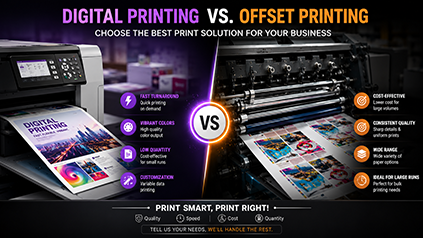

In today’s competitive business environment, printed marketing materials continue to play a vital role in building brand awareness and attracting customers. Whether you’re producing business cards, brochures, product packaging, catalogs, flyers, labels, or promotional materials, selecting the right printing method can significantly impact quality, cost, and turnaround time.
The two most popular commercial printing methods are digital printing and offset printing. While both produce professional results, each has its own advantages depending on your project’s size, budget, timeline, and customization requirements.
If you’re unsure which printing method is right for your business, this comprehensive guide explains everything you need to know.
Digital printing is a modern printing process where digital files are printed directly onto paper, cardboard, vinyl, or other materials without using traditional printing plates.
Unlike conventional printing methods, digital printers transfer the artwork directly from a computer to the printer, making the process faster and more flexible.
Digital printing is commonly used for:
Because there is little setup involved, digital printing is ideal for short-run printing projects.
Offset printing is a traditional commercial printing technique that transfers ink from metal plates onto rubber blankets before applying it to paper.
Although the setup process takes longer and requires printing plates, offset printing delivers exceptional color consistency and high-quality results for large print volumes.
Offset printing is commonly used for:
It remains the preferred choice for businesses requiring thousands of identical printed pieces.
The digital printing process is relatively straightforward:
Since no printing plates are required, setup time is minimal.
Offset printing follows several additional steps:
Although setup takes longer, the process becomes extremely economical for large quantities.
One of the biggest questions businesses ask is:
Which printing method offers better quality?
The answer depends on your project.
Modern digital printers produce impressive sharpness and vibrant colors.
Advantages include:
For most marketing materials, digital quality is more than sufficient.
Offset printing is still considered the gold standard for premium commercial printing.
Benefits include:
Luxury brands often choose offset printing because of its premium appearance.
Budget is one of the biggest deciding factors.
Digital printing has:
For example:
Printing 100 brochures digitally is usually much cheaper than offset printing.
Offset printing includes:
These setup expenses make small jobs more expensive.
However, once setup is complete, the cost per piece drops dramatically.
For example:
Printing 20,000 brochures using offset printing costs significantly less per brochure than digital printing.
If speed matters, digital printing has a clear advantage.
Perfect for:
Offset printing requires:
Large projects may take several days before delivery.
Color consistency is essential for brand identity.
Digital printing produces excellent color accuracy but slight variations may occur between different print runs.
Most businesses won’t notice these differences.
Offset printing excels at:
This makes it the preferred choice for global brands.
One of digital printing’s greatest strengths is personalization.
Examples include:
Every printed piece can be different without slowing production.
Offset printing cannot efficiently produce personalized prints.
Both printing methods support various materials.
Compatible with:
Works exceptionally well with:
Digital printing is ideal when you need:
Examples include:
Offset printing is better for:
If you’re printing thousands of copies, offset is usually the better investment.
Sustainability has become increasingly important for businesses.
Digital printing generates:
Because there are no plates, fewer materials are consumed.
Offset printing has improved significantly with eco-friendly inks and recycling practices.
However, it generally produces:
For very large production runs, offset can still be efficient due to lower waste per printed piece.
| Feature | Digital Printing | Offset Printing |
|---|---|---|
| Setup Time | Very Fast | Longer |
| Initial Cost | Low | High |
| Large Quantity Cost | Higher | Lower |
| Print Quality | Excellent | Exceptional |
| Color Accuracy | Very Good | Outstanding |
| Personalization | Yes | Limited |
| Turnaround | Fast | Moderate |
| Best For | Small Runs | Large Runs |
The right choice depends on your specific needs.
Choose digital printing if you:
Choose offset printing if you:
Many companies combine both printing methods to maximize efficiency.
For example:
Using both methods strategically allows businesses to balance speed, quality, and cost.
Both digital and offset printing have their place in modern printing. Neither method is universally better—the best choice depends on your project’s size, budget, timeline, and quality expectations.
Digital printing is ideal for short runs, quick turnaround, and personalized materials, making it perfect for startups, small businesses, and fast-paced marketing campaigns. Offset printing remains the industry standard for large-scale production, offering unmatched color accuracy, premium quality, and lower costs per unit for high-volume jobs.
Before starting your next print project, consider your quantity, deadlines, customization needs, and desired finish. Partnering with an experienced printing provider can help you choose the most cost-effective solution while ensuring your printed materials reflect your brand’s professionalism and quality.
Whether you’re printing custom packaging, marketing materials, or promotional products, selecting the right printing method will help you achieve the best results and maximize your return on investment.
The Complete Guide to Professional Printing Services for Businesses in 2026 In an increasingly
How to Prepare Print-Ready Files for Perfect Results Every Time Whether you’re printing

Leave a comment